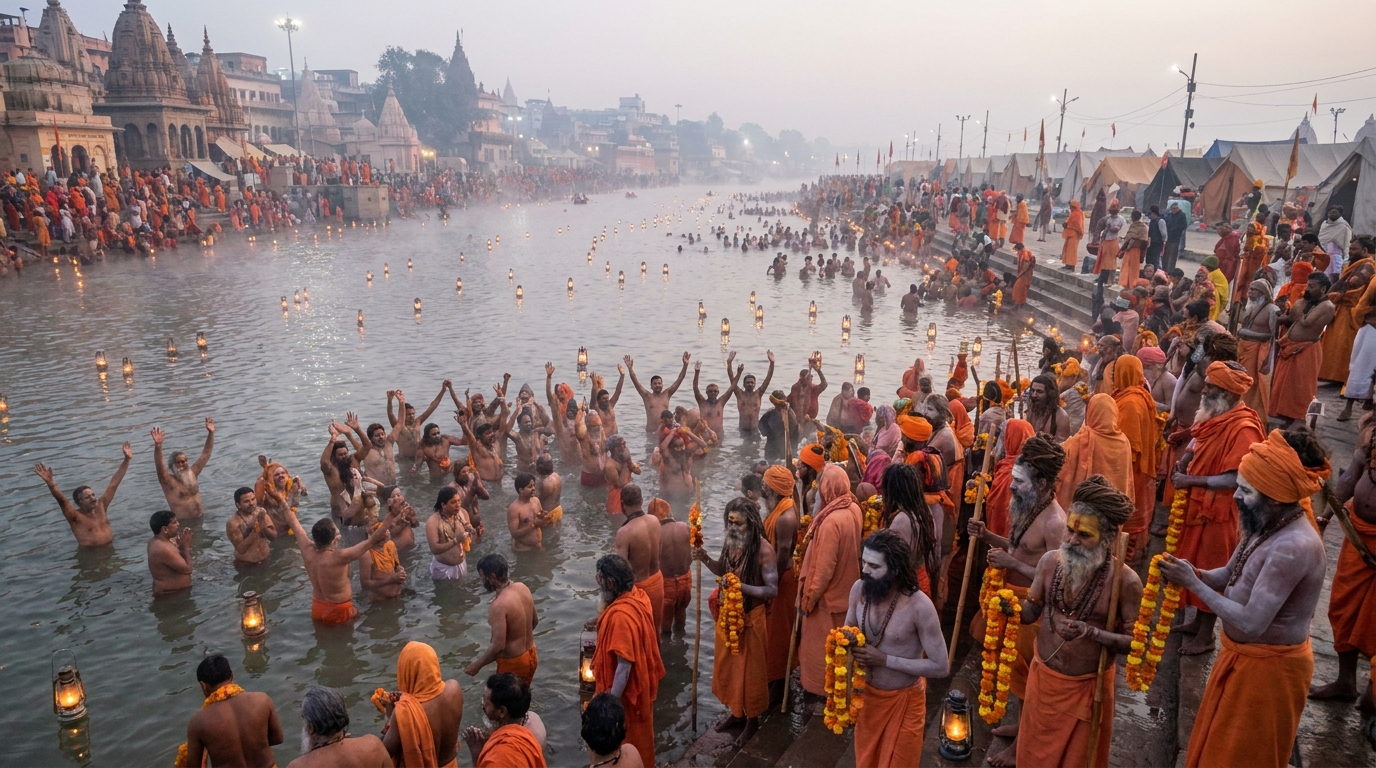
What is the Kumbh Mela?
The Kumbh Mela is a Hindu pilgrimage and festival centred on the ritual of snan — bathing in a sacred river at an astrologically ordained moment. It is widely recognised as the world's single largest peaceful gathering, with total attendance across a full Kumbh cycle sometimes exceeding 100 million people.
The word Kumbh means "pot" or "pitcher." The festival takes its name from the mythological Samudra Manthan — the churning of the cosmic ocean by the gods and demons to produce amrit (the nectar of immortality). As the gods carried the pot (kumbh) of amrit across the heavens, drops fell at four places on Earth, sanctifying the rivers there. Those four places became the four Kumbh sites.
The Kumbh is not a single event but a season of pilgrimage — typically spanning several weeks — with the most auspicious bathing days called the Shahi Snan (royal bath), when processions of akharas (ancient orders of Hindu saints and sadhus) lead the way to the river.
The Simhastha cycle — why every 12 years?
The timing of each Kumbh is determined by Vedic astrology — specifically the positions of Jupiter (Brihaspati), the Sun and the Moon relative to the zodiac signs. Jupiter's orbit around the Sun takes approximately 12 years, so the planetary alignment that triggers a Kumbh at a given site recurs roughly every 12 years.
The Nashik–Trimbakeshwar Kumbh is called the Simhastha because it is held when Jupiter (Brihaspati) enters the sign of Leo (Simha rashi). The Ujjain Kumbh shares this Simhastha name for the same reason — though its precise planetary condition differs slightly. The 2027 Simhastha at Nashik–Trimbakeshwar is the first since 2015 and will not recur until 2039.
The four Kumbh Mela sites
The Kumbh rotates among four sacred sites across India, each associated with a sacred river and a different planetary combination:
| Site | Sacred river | Planetary trigger | Note |
|---|---|---|---|
| Prayagraj | Triveni (Ganga, Yamuna, Saraswati) | Jupiter in Taurus, Sun in Capricorn | Largest attendance of all four |
| Haridwar | Ganga | Jupiter in Aquarius, Sun in Aries | Gateway of the Ganga |
| Ujjain | Shipra | Jupiter in Leo, Sun in Aries | Simhastha; city of twelve jyotirlingas |
| Nashik–Trimbakeshwar | Godavari (Dakshina Ganga) | Jupiter in Leo, Sun in Leo | Simhastha 2027; Jyotirlinga at source2027 |
What is the Shahi Snan?
Shahi Snan literally means "Royal Bath." It refers to the ritual bathing processions led by the thirteen akharas — the major orders of Hindu ascetics, including Naga Babas (warrior-monks), Vairagi saints and Udasin saints — who process to the river in elaborately decorated palanquins, on horseback and on foot, accompanied by music, elephants and millions of followers.
The akharas bathe first in a fixed order of precedence at the most auspicious hour (typically before dawn). Public bathing windows then open, and pilgrims join in throughout the day. The moment of the Shahi Snan is considered the most potent of the entire Kumbh — when the accumulated spiritual power of the assembled saints is believed to pass into the river's waters.
The Shahi Snan dates for the 2027 Nashik–Trimbakeshwar Simhastha are:
- 012 August 2027First Shahi Snan
- 0231 August 2027Second Shahi Snan
- 0311 September 2027Third Shahi Snan
- 0412 September 2027Final Shahi Snan
Why Nashik–Trimbakeshwar 2027 is special
Of the four Kumbh sites, Nashik–Trimbakeshwar holds a unique distinction: it is the only site where a Jyotirlinga of Lord Shiva stands at the very source of the sacred river. The Trimbakeshwar Jyotirlinga — the 10th of the twelve — sits at the foot of Brahmagiri hill where the Godavari first emerges.
This means the 2027 pilgrimage offers something unavailable at any other Kumbh: a single journey that combines the Jyotirlinga darshan with the Shahi Snan in the Godavari — both considered acts of the highest spiritual merit in Hindu tradition.
Additionally, the Godavari is called the Dakshina Ganga — the Ganga of the south — and bathing in it during the Simhastha is believed to confer the same liberation from the cycle of rebirth (moksha) as bathing in the Ganga at Haridwar or Prayagraj.
What pilgrims actually experience
For most pilgrims, the Kumbh is a life-defining event — both spiritually and practically. Here is what to expect:
- The crowds: On Shahi Snan days, millions converge at the ghats. Traffic is managed with one-way flow; pilgrims walk or take managed shuttles to the river. The energy is unlike anything else.
- The akharas: The processions of Naga Babas and saints are awe-inspiring — ash-covered, trident-carrying and chanting, they represent an unbroken living tradition thousands of years old.
- The sound: All-night bhajans, temple bells, conch shells and the hum of millions in prayer create a continuous soundtrack of devotion.
- The darshan: Visiting the Trimbakeshwar Jyotirlinga on a Shahi Snan day is considered especially auspicious, though queues are long — arrive early or arrange a VIP darshan slot.
- The rest: Between the snan and the temple, pilgrims rest, eat sattvic food and join evening aartis on the river. Proximity to the ghats and comfortable, private accommodation makes this possible without exhaustion.
Planning to attend the 2027 Simhastha?
Trimbakeshwar Tent City offers managed pilgrimage accommodation 1.5–3 km from the Godavari ghats and Jyotirlinga temple. Private washrooms, sattvic meals, 24/7 security and a dedicated shuttle on every Shahi Snan day. Three tiers — Deluxe, Premium and AC Luxury.