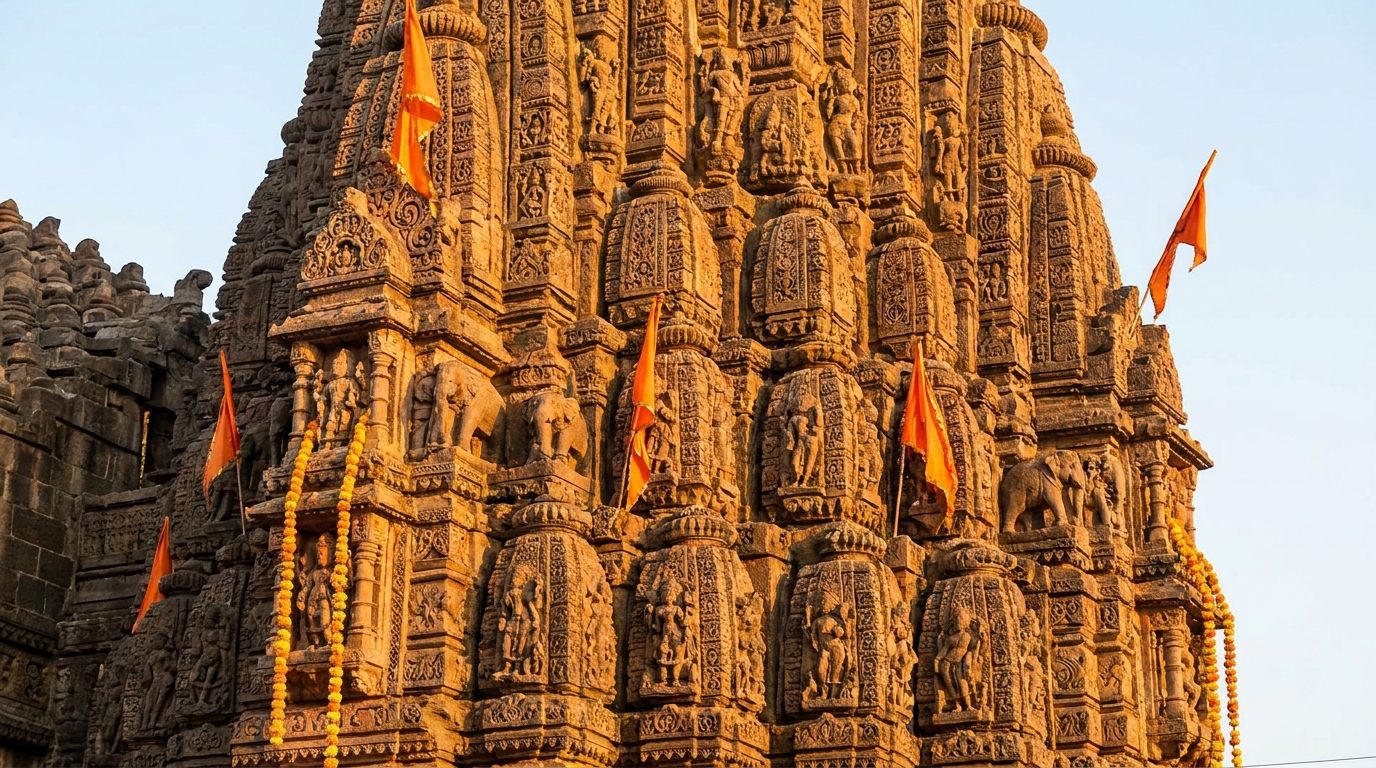
What is the Trimbakeshwar Jyotirlinga?
The Jyotirlingas are twelve manifestations of Lord Shiva as a column (linga) of infinite radiant light (jyoti). Of the twelve, Trimbakeshwar is singular: its linga has three faces (Trimukhi), each representing one member of the Hindu Trimurti — Brahma the creator, Vishnu the preserver and Mahesh (Shiva) the destroyer. The name itself means "Lord of the Three Peaks" — Brahmagiri, Nilgiri and Kalagiri — the three hills that surround the town.
The presiding deity is Trimbakeshwar Mahadev, and the temple traces its origins to antiquity, though the present structure in the Hemadpanthi architectural style was built in the 12th century and substantially restored under Peshwa Nana Saheb Peshwa in the 18th century.
The Godavari connection
The Godavari — called the Dakshina Ganga (Ganga of the South) — is one of India's longest and holiest rivers. It originates at Brahmagiri hill, directly above the Trimbakeshwar temple, at a spot called Gangadwar where the river first emerges from the earth.
Within the temple complex itself lies the Kushavarta Kund, a sacred tank where the Godavari is believed to first appear at the surface. Bathing in Kushavarta Kund is considered equivalent to bathing in the Ganga for those who cannot reach northern India — a belief that draws pilgrims year-round, but especially during the Kumbh.
During the Simhastha Kumbh Mela, bathing in the Godavari at Nashik and in Kushavarta Kund at Trimbakeshwar on the Shahi Snan dates is believed to cleanse the karma of many lifetimes.
Architecture and temple layout
The temple is a classic example of the Hemadpanthi style — characterised by black stone construction, intricate carvings, a tall shikhara (spire) over the sanctum and ornate mandapas (halls). Built primarily of locally quarried basalt and limestone, the temple complex includes:
- Garbhagriha (inner sanctum) — houses the three-faced Jyotirlinga, partially submerged in a pit and visible only through a golden-encased opening.
- Sabha Mandapa — a large ceremonial hall for gatherings and rituals.
- Kushavarta Kund — the sacred tank within the complex, surrounded by ghats and bathing steps.
- Nandi Mandapa — a shrine to Nandi (the sacred bull, Shiva's vehicle) facing the main shrine.
- Outer prakara — a walled courtyard with smaller shrines to Devi, Ganesh, the Navagrahas and other deities.
The Trimbakeshwar temple and Kumbh Mela 2027
The Nashik–Trimbakeshwar Simhastha Kumbh Mela is held when Jupiter (Brihaspati) enters the zodiac sign of Leo (Simha rashi). The next occurrence is in 2027, making the upcoming Kumbh the first in twelve years at this location.
During the Kumbh, the spiritual significance of the Trimbakeshwar Jyotirlinga is magnified. The thirteen akharas — orders of Hindu ascetics — process to the Godavari for the Shahi Snan (royal bathing). The four principal dates in 2027 are:
- 012 August 2027First Shahi Snan
- 0231 August 2027Second Shahi Snan
- 0311 September 2027Third Shahi Snan
- 0412 September 2027Final Shahi Snan
Pilgrims who wish to take the Shahi Snan and visit the Jyotirlinga in a single trip should plan to stay near Trimbakeshwar for at least 2–3 nights around their chosen Snan date.
How to reach Trimbakeshwar
Trimbakeshwar is located 28 km west of Nashik in Maharashtra. All routes converge on Nashik before the final stretch:
| Mode | Gateway | Travel time to Trimbakeshwar |
|---|---|---|
| Air | Nashik Airport (ISK) | ~1.5 hours by taxi |
| Air (international) | Mumbai (BOM) | ~4–5 hours by road |
| Train | Nashik Road (NK) | ~1 hour (~40 km) |
| Road | Mumbai / Pune Expressway | 4–6 hours self-drive |
On Shahi Snan days, private vehicles are restricted near the temple and ghats. Managed accommodation with its own ghat shuttle is by far the easiest way to navigate these peak days.
Darshan tips for pilgrims
- Arrive early: The temple opens at 5:30 am. Kakad Aarti (dawn prayer) is the least crowded and most atmospheric time for darshan.
- Dress code: Traditional attire — dhoti/kurta for men, saree or salwar for women. Covering your head is respectful. Remove footwear at the entrance.
- No photography inside the sanctum. Leave cameras and phones at the cloakroom.
- Abhishek booking: Special Rudrabhishek or Laghurudra puja can be booked through temple trust counters — do so a day ahead during the Kumbh.
- Medical support: If travelling with elderly family, choose accommodation with on-site medical facilities and rest time planned between the darshan and Snan.
Staying near the Trimbakeshwar Jyotirlinga for Kumbh 2027
Trimbakeshwar Tent City is a managed pilgrimage camp 1.5–3 km from the temple and Godavari ghats. Every tent includes a private washroom, real bed, daily meals and a shuttle to the Shahi Snan bathing points. Three comfort tiers — Deluxe, Premium and AC Luxury — suit every group.